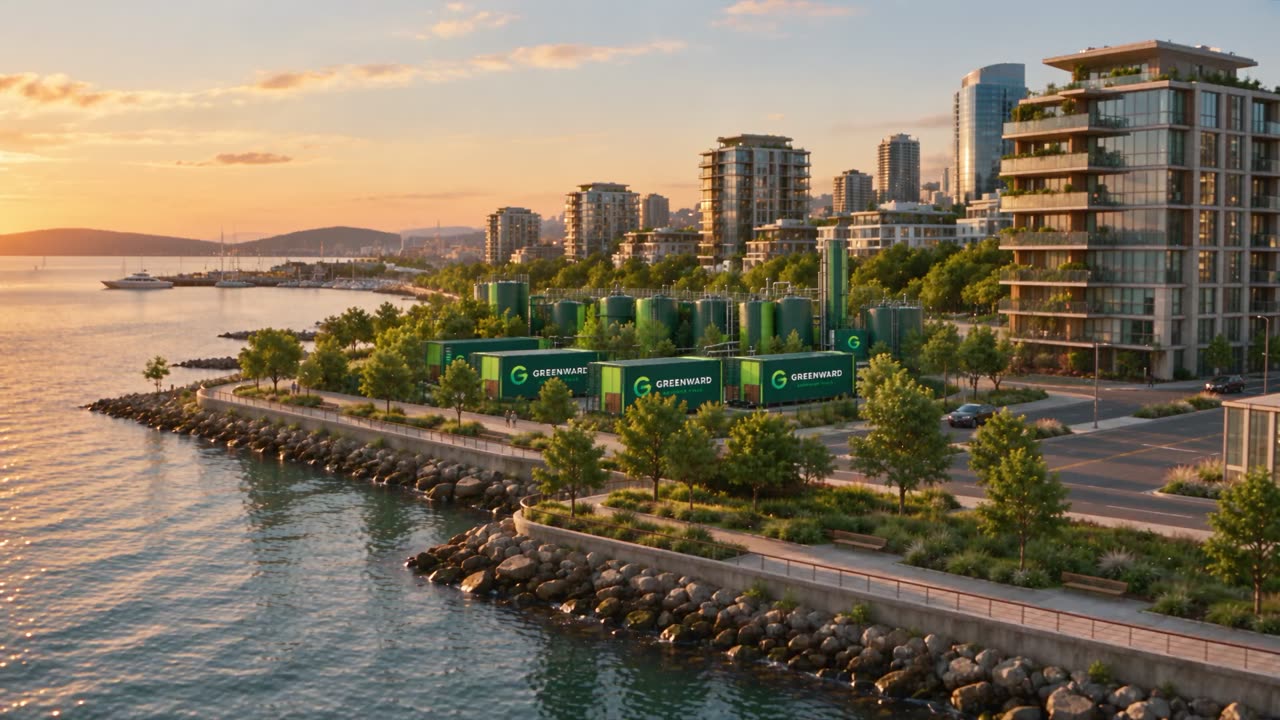
Cleaner fuels.Stronger planet.Further together.
Greenward turns advanced fuel innovation into real-world progress: proprietary bioprocessing that converts paper-industry residues and other wastes into high-grade bioethanol, built, owned and operated at commercial scale, wherever the waste already is.
Containerised. Modular.
Deployable anywhere.
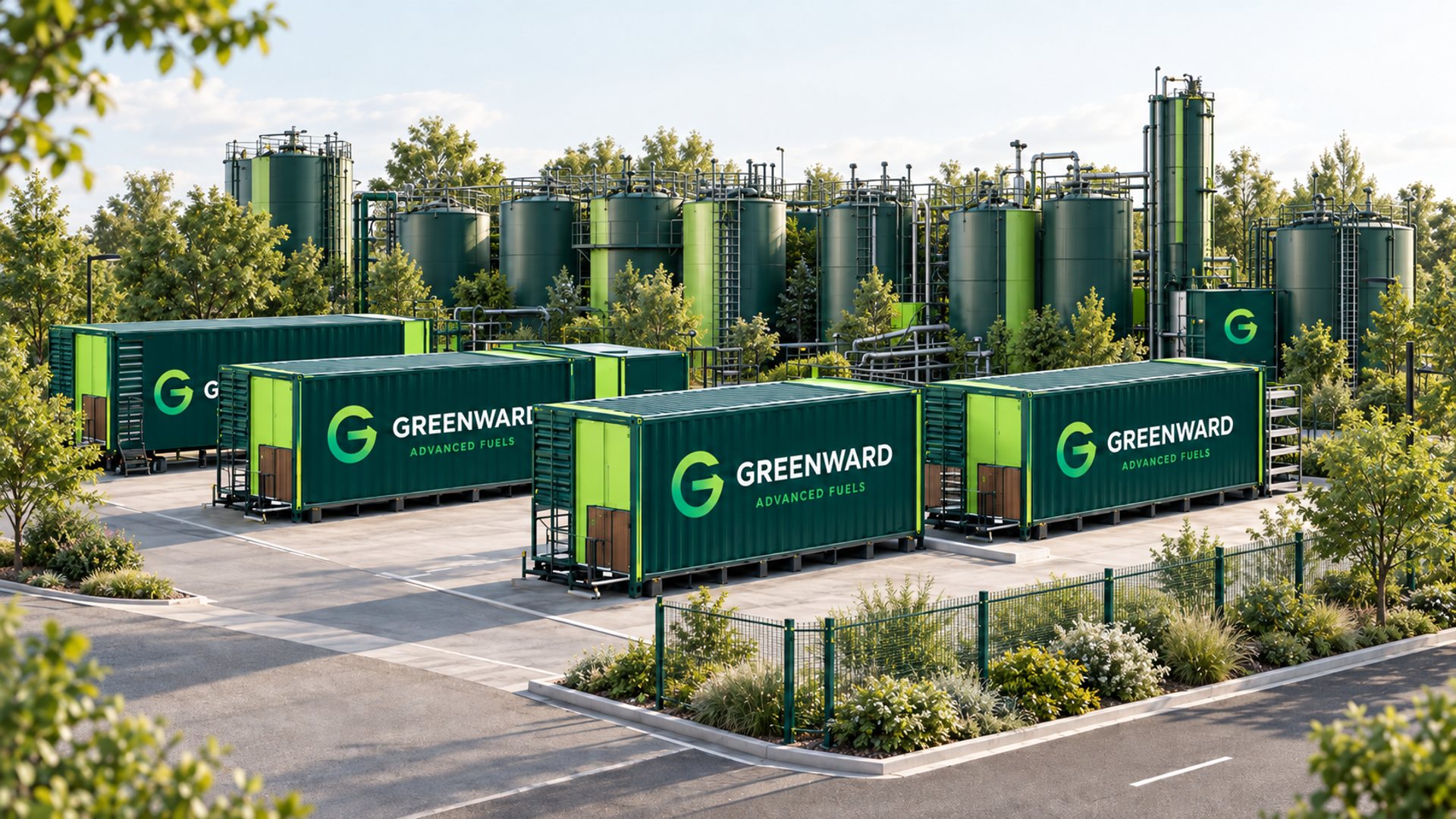
Factory-built in 5 months. Installed in 6 to 8 weeks. Under 1 acre. The complete Greenward system arrives ready to operate, wherever the waste already is.
A broken system
that wastes value.
The UK produces 3.5 million tonnes of sewage sludge annually. Nearly 90% is spread on agricultural land, contaminating soils with PFAS, microplastics and heavy metals.
Domestic bioethanol production has collapsed. Vivergo closed in 2025. The UK now imports virtually all of its 1.4 billion litres of annual demand.
Greenward solves both problems simultaneously.
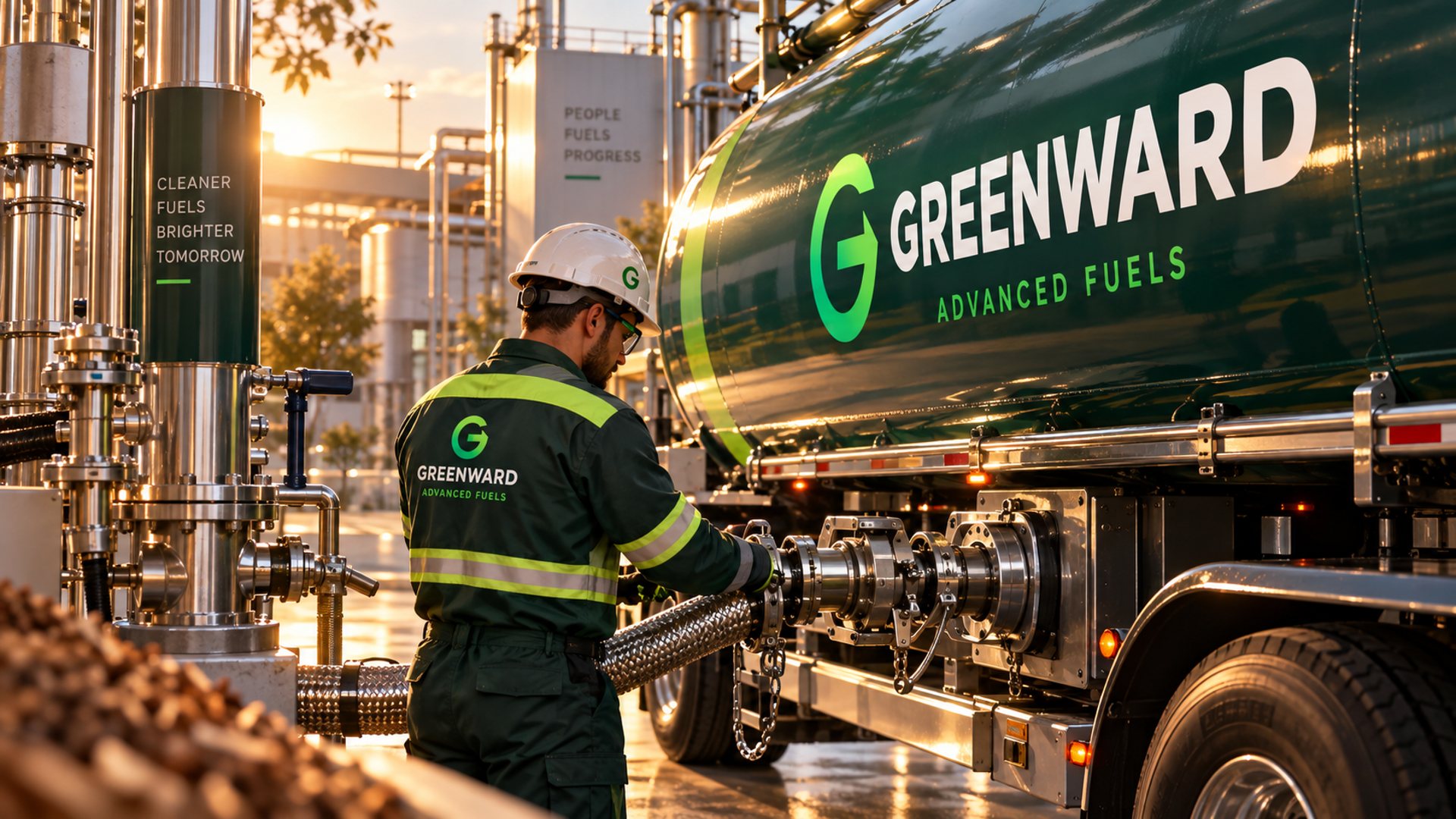
Engineered in-house.
Tested on real waste.
Designed by Greenward's own engineering team from detailed analysis of current and historic plants, white-paper reviews and practical engineering assessments. Paper-waste trials positive. Calcium carbonate recovery positive at 95 percent removal. Independent engineering validation under way ahead of Plant 1, with process science that has run at Stellenbosch University.
Plant figures: Bio-Agri heat and mass balance, September 2026 (100,000 tonnes a year basis). Planning figures, validation under way.
Eight structural advantages
no competitor can replicate.
Supply agreed at site one. Offtake in negotiation. Technology validated. This is a system taking shape, not a project looking for customers.
Greenward is not building a plant and then looking for feedstock. The first facility is sited with its feedstock supplier under agreed heads of terms, including a long-term inflation-linked lease with consistent, contaminant-free volumes. Greenward is building supply relationships covering millions of tonnes of annual arisings across paper, green waste, and sludge streams.
Greenward is in active offtake negotiations with some of the largest energy and commodity buyers in the world, across fuel blending, industrial, pharmaceutical and specialty markets. The route to revenue is mapped, priced and in negotiation.
Waste producers pay gate fees to have their waste accepted. Six independent revenue streams: waste gate fees, bioethanol sales, RTFCs, the double waste-derived certificate rate (classification application with the DfT), carbon credits (subject to LCA and registry approval), and CO₂ capture. Gate fee revenue lands before a single litre leaves the plant. A revenue structure no grain-based competitor can match.
Anaerobic digestion takes 40+ days. The Greenward process completes the full cycle, from preconditioning through to ethanol production, in under 48 hours. Each unit is factory-precommissioned before it arrives on site, cutting deployment risk and ramp-up time to a minimum. A fundamentally different speed of capital deployment, return, and operational throughput.
The Greenward process was engineered by our own team from detailed analysis of current and historic plants, white-paper reviews and practical engineering assessments, then trialled on the feedstocks it will run on. Paper-waste trials positive. Calcium carbonate recovery positive at 95 percent removal. Independent engineering validation is under way ahead of Plant 1, so the numbers investors see will be verified, not ours.
Eligible waste-derived bioethanol earns 2 Renewable Transport Fuel Certificates per litre, double the rate for crop-based ethanol. Greenward's feedstock classification applications are with the DfT. A pricing advantage set by UK regulation, not market conditions.
There is no commercial-scale waste-to-bioethanol operation in the UK. Greenward's first plant will be the first. The moat is technology access, operational knowledge, and first-site feedstock agreed under heads of terms, not just timing.
Unlike biodiesel and UCO markets, which were cannibalised when feedstock prices rose and imports flooded in, the Greenward process handles paper waste, organic materials, grasses, water hyacinth, and cellulosic sewage sludge. The breadth of compatible feedstocks is a structural moat: when one stream tightens, others absorb the volume. The supply risk that destroyed the UCO market does not apply here.
The UK bioethanol industry
just collapsed.
The May 2025 UK-US trade deal removed the 19% tariff on US ethanol imports. Vivergo closed. Ensus mothballed. Greenward occupies uncontested territory.
Explore the marketQuestions about Greenward,
answered plainly.
What does Greenward do?+
Greenward converts paper-industry residues and other lignocellulosic wastes into bioethanol, calcium carbonate and captured CO2. It builds, owns and operates containerised plants where the waste already is, and waste producers pay a gate fee to have their material accepted.
How does the Greenward process work?+
A proprietary enzyme cocktail, not acid, breaks the cellulose in the waste into fermentable sugars at mild temperature. Yeast converts the sugars to ethanol in staggered fermenters in under 48 hours. Distillation takes the ethanol to 95 percent or higher purity, the EN15376 grade accepted by UK and EU fuel suppliers. Lignin fuels the plant boiler, water is recycled by reverse osmosis, CO2 is captured and calcium carbonate is recovered from the paper fillers. Nothing goes to landfill.
What does one Greenward plant produce?+
One plant processes 100,000 tonnes of waste a year and produces up to 6.5 million litres of bioethanol, 28,300 tonnes of calcium carbonate and 4,900 tonnes of captured CO2. These are planning figures from the Bio-Agri heat and mass balance of September 2026, with independent engineering validation under way ahead of Plant 1.
Is Greenward the same company as Greenward Energy, the solar installer?+
No. Greenward (greenward.energy) is a UK advanced fuels business turning waste into bioethanol. Greenward Energy Ltd is an unrelated solar panel installer in Hampshire. The two share no ownership, staff, plants or projects.
Why does the UK need waste-derived bioethanol?+
The UK uses about 1.4 billion litres of bioethanol a year and, after the closure of Vivergo and the mothballing of Ensus in 2025, produces almost none of it domestically. Eligible waste-derived bioethanol earns two Renewable Transport Fuel Certificates per litre under the RTFO, double the crop-based rate, and there is no commercial-scale waste-to-ethanol plant in the UK today.
Ready to deploy
waste-to-value at scale?
Whether you're an investor, site operator, offtaker or water company, we'd like to hear from you.